Basics of Vedic Astrology
This series of blog posts is being written without dealing with the mathematical part. If you read it step by step and then see your own and others’ horoscope, you will be able to understand, technically, the astrological discussion. You will also get familiar with the terminology of Hindu astrology.
1. To do that remember the first lesson in three parts: start counting the weekdays – Sunday, Monday, Tuesday, Wednesday, Thursday, Friday and Saturday. These seven days represent seven planets – Sun, Moon, Mars, Mercury, Jupiter, Venus and Saturn.
2. In Hindu astrology we make use of two other planets, called the shadowy planets, called Rahu and Ketu.
This gives you a total of nine planets. It is why we have the famous navagraha stotra or worship of nine planets.
Note – In Hindu astrology we do not use, Uranus (Herschel), Pluto and Neptune. In the scheme of stotra these planets have no place though an American has given mantras for these three planets also in his book which is not given in any book of Hindu astrology we have or know of.
Note – Now, also remember the sacred number 108 which are the number of beads we have in the garland, of tulasi or rudraksha with which we do our japam.
3. The part of the first lesson is: there are twenty seven nakshatras that we make use of in Hindu astrology. It is a very remarkable, brilliant and subtle division which is being explained later. Each nakshatra has four equal parts. Again you will see that twenty-seven multiplied by four gives you one hundred and eight number (108) which are the number of beads we have in the garland, of tulasi or rudraksha with which we do our japam.
A horoscope is a diagram. A horoscope is also described as a map of man’s destiny. South Indians and north Indians use different diagrams. There is no difference in the predictions given on their basis.
Note – In the north Indian form the lagna is not shown, as it has always to remain at the top centre.
Now you must know something about the twenty-seven nakshatras. Each nakshatra takes 13 degrees and 20 minutes uniformly. If 13°20 is multiplied by 27 it gives you 360 which is the total equal to the twelve houses.
Importance of Lagna, Moon and Janma Nakshatra
Remember that in Hindu astrology three most important descriptions of any horoscope are always necessary. If you are asked to describe the briefest but the most important pivots of your horoscope, you should be able to tell-
- What was the Lagna you were born with?
- What was the Moon sign?
- What was Janma Nakshatra of your birth?
Check List One (Birth Details)
1. POB – Has the place of birth been noted down correctly with its correct Latitude and Longitude?
2. DOB – Has the date of birth been noted correctly.
Note – Remember in India, our day is from one sunrise to another sunrise. So if anyone is born, say at 01:40 am. of 15 February, the question you must ask is-
- Is it 14/15 February midnight or is it 15/16 February midnight.
If you do not want to care for such details, you are not learning astrology sincerely.
3. TOB – The trickiest area for the preparation of a horoscope is the accurate birth time. Now understand different practices:
- In astrology-conscious families, the birth time is noted down upto seconds.
- Hospital time is dependable but rarely accurate. Doctors and nurses are anxious to save the mother and the baby and are least bothered about the accurate birth time.
- If the birth time is given vaguely, as happens as many people say.
4. Twins – You may be aware that all critics of astrology ask you to explain why twins have different fates. The astrological answer is that their birth details are never recorded most accurately upto seconds, which is absolutely necessary.
Happy and Unhappy Conditions of Planets
Planets have different conditions and different moods. The condition of planets in a horoscope reflects it.
Note – Do not take it literally because there are many brilliant exceptions to these rules. If that is not remembered, only a gloomy and fatalistic view of a horoscope will have to be taken, as many astrologers do.
Just as the company of different human beings and different surroundings create different moods in you so do planets in a horoscope. Planets are happy in some conditions and unhappy in some other conditions. There are varying emotional states.
Caution – Before you learn the following lesson, overcome the mechanistic attitude of the age we live. Astrology of Hindus is not a set of formulae to be applied in a push-button way. What is being given here is for a quick understanding of the fundamentals only. Do not take them as final pronouncements. If you commit that mistake, you will become dogmatic.
Hindu astrology is world’s most developed astrology because India is the land where astrology originated and, was developed over a period of thousands of years. Here many astrological experiments have been done and many techniques tested and re-tested. Avoid dogma but follow the steps given below. The more flexible but, not romantically stupid, you are in learning astrology, the better are the chances of your developing proper astrological ability.
Remember It Step By Step
1. A planet is in an extremely happy condition when it is exalted and is in an extremely miserable condition when it is debilitated (It is not always true, But this fundamental principle is useful for prediction). When and upto what degrees in a sign is a planet exalted is the first lesson you learn.
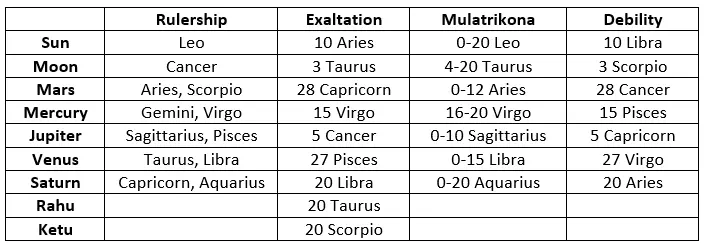
Note – Except Mercury who is exalted in Kanya no other planet gets any exalted status in its own house.
Note – All exalted planets get debilitated in the seventh house from their points of exaltations.
For instance the Sun is exalted in Mesha. Now count in this way – Mesha first, Vrisha second, Mithuna third, Karka ending with Tula which is the seventh house from Aries.
2. Moolatrikona – The second best condition for planets is called as the Moolatrikona.
Note – Except the Moon all other planets get the Moolatrikona condition in one of their own houses.
3. Own House – The third best condition for a planet is to be in its own house (other than Moolatrikona house which, except in the case of the Moon is of course in its own house).
Note – Sun, Mars, Mercury, Jupiter, Venus and Saturn recognize the same house in which they are in a moolatrikona condition, as their own houses. But their other houses are also their own houses. The only exception is the Moon.
These are three of the happiest conditions for planets in different houses.
4. Next a planet is happy in the house of a friend.
Friendships of the Planets
In Vedic astrology, planetary friendships define how planets interact, with relationships classified as natural (permanent) or temporary based on their positions in a horoscope. They are grouped into two camps: Devas (Sun, Moon, Mars, Jupiter) and Assuras (Venus, Saturn, Mercury, Rahu, Ketu), which dictate their friendly or hostile, or neutral behavior toward one another.
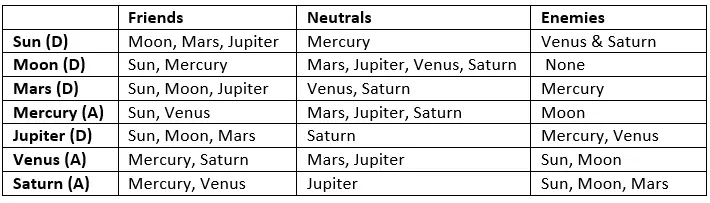
Never overemphsise the friendships or enmity factor. Lot of new factors have to be looked into and new research has to be done.
All that is being stressed here is remember the principle but do not overstress these factors. Also do not ignore them. The art of judgement in astrology is the art of developing a judicial balance. In various ancient texts, different results are given for the conditions of planets.
They, if used liberally, not literally make an astrologer avoid dogmatic interpretation of horoscopes, a very common weakness and fault of astrologers. Given below is the result of different conditions with certain remarks.
Ascribed Result
1. Exalted – Gives courage, valour high positions etc.
2. Moolatrikona – Favours come in many ways. Wealth, position, learning etc.
Note – Jupiter and Mercury in exaltation or Mooltrikona have been found to be promoting idealism, learning, authorship etc.
3. Own House – Generally favourable. On the balance more good than bad results have been seen.
4. Great Friend’s – Generally good. Has not been found to be very extraordinary.
5. Friend’s House – Generally peaceful. Generally one is cheerful genial in behaviour.
6. Neutral’s House – Enmities, sicknesses. It is correct always. But one will have to try hard to achieve success.
7. Enemy’s House – Open hostility is visible.
8. Debilitated – Generally unfavourable. It has not been found to be so.
In fact debilitated Saturn and Mars give humility. Debilitated planets have to have their weaknesses. They manifest in different ways at different times.
Caution
1. The above given results get modified through the association or aspects of other planets with them. They can improve or get worse.
2. A planet within, say, about three degrees of the Sun is said to be combust and is said to give bad results. In our experience it is not always so, though for a brief period there can be mental pain.
3. A planet defeated in a planetary war is the planet which is almost of the same degree as another one (not the Sun and other exceptions). This has been interpreted also differently by different writers. There is no sound research to guide us.
4. A planet when retrograde (other planets except the Sun, the Moon) gets into retrograde motion. Read a little bit of astronomy to learn about it). No astrologer should jump to any conclusion without a sound research and observation.
Note – The interpretation of the results of all these, particularly of retrograde planets has been mostly done through loose generalisations. Such an approach and tendency must be avoided.
Your Lagna
In Vedic astrology, the Lagna (or Ascendant) is the zodiac sign rising on the eastern horizon at the exact moment and place of birth. It represents the first house of the birth chart, signifying the native’s physical body, personality, and outward approach to life. It is considered the most critical factor for interpreting a horoscope.
Your Moon Sign
Your Moon sign (or Rashi in Vedic astrology) represents the zodiac sign the Moon was occupying at the precise moment of your birth. The Moon sign rules your inner world—emotions, instincts, subconscious patterns, and deepest needs.
Because the Moon moves quickly, changing signs every 2.5 days, your Moon sign is highly personal and requires your exact birth time, date, and location to calculate accurately.
Your Janma Nakshatra
On the basis of your Moon, you can see what was your Janma nakshatra (or birth constellation). It has to be one of the twenty-seven constellations.
1. Your janma-nakshatra is important for calculating the time-cycle described as the Vimshottari dasha of 120 years. Depending on your janma nakshatra what period of which planet your are passing through is the most vital factor for predictions.
2. If you were born in the nakshatra of Ketu (7 years) it will be followed by that of Venus (20 years) etc. See the chart on nakshatras.
3. These are called mahadashas. Each mahadasha is sub-divided into nine antar-dashas or sub-periods, and each antar-dasha is sub- divided into nine pratyantar dasha, each prayantar dasha is divided into nine sookshma dashas, each sookshma dasha is divided into nine prana dasha. This five-fold division of dasha is the most extraordinary and unparalleled system of timing events in the history of astrology.
4. Do not be surprised if I tell you that though the Vimshottari dasha is the most popular, in Hindu astrology there are forty-five Jaimini dasha-systems and another fifty-four nakshatra dasha systems of Parashara, the greatest astrological genius the world has ever produced.
5. We will be using only the Vimshottari dash in our this blog post series and all our illustrations will refer to
- The Mahadasha (the major period)
- The Antar dasha (the sub-period) and
- The Pratyantar dasha (the sub-sub-period) only.
No use of the fourth division (sookshma dasha or the fifth division prana dasha) is being made use of here. But in two cases when I made use of where I was absolutely assured that the birth time noted was without any error and the calculation of the horoscope was cast hundred percent correct.
Warning
1. Do not jump to any conclusion, generally pessimistic or optimistic, only on the basis of the dasha-antardasha etc. But rest assured the sixty percent of correct predictions are based on it. This is the best ever method of timing events ever devised by mankind.
2. After you have become familiar with the use of the dasha system, use transits of planets. Those who over-emphsise the role of transit of planets without first examining the promised results of dasha, are like people who are measuring the size of an elephant on the basis of the length its tail. But first revise what you have been taught so far, step by step.
Aspects
Aspect of planets is the first preliminary step that takes you into predictive astrology. These aspects are general and special. Let me first take up general aspects.
All planets aspect the seventh house form their position. Three planets Mars, Jupiter and Saturn have special aspects.
- Mars has two additional aspects the fourth and the eighth.
- Jupiter has two additional aspects the fifthe and the ninth.
- Saturn has two additional aspects the third and the tenth.
So Mars, Jupiter and Saturn will have three aspects, one general and two special.
You must remember that planets give their effects not merely from where they are in a horoscope but also produce these effects in the house which they aspect.
The PAC Memory Tablet
In the state of Uttar Pradesh there is a special branch of police known as PAC created to control communal riots.
But the astrological PAC is meant to control anarchical and chaotic analysis of a horoscope.
- P(position)
- A(aspect)
- C(conjunction)
Therefore I have evolved a memory tablet, the first part of which is PAC-P stands for the position a planet has occupied in a horoscope.
Instead of taking fragmentary, confused and unsynthesized view, it is better, to proceed systematically so that you are able to arrive at a meaningful conclusion.
In all horoscopes first of all see how the lord of a particular house is placed.
Therefore let me read a sermon to you first a dangerous sermon, which if you remember, you will not take a fragmentary, muddle-headed and jumbled view of a horoscope.
Sermon One
1. Hindu astrologers are in the habit of referring to what they think are classics with infallible principles and they turn them into dogmas. They invite disaster.
2. Hindu astrologers are in the habit of turning these dogmas their predictive base. They invite greater disaster.
नमस्कार । मेरा नाम अजय शर्मा है। मैं इस ब्लाग का लेखक और ज्योतिष विशेषज्ञ हूँ । अगर आप अपनी जन्मपत्री मुझे दिखाना चाहते हैं या कोई परामर्श चाहते है तो मुझे मेरे मोबाईल नम्बर (+91) 7234 92 3855 पर सम्पर्क कर सकते हैं । परामर्श शुल्क 251 रु है। पेमेंट आप नीचे दिये QR CODE को स्कैन कर के कर सकते हैं। कुंडली दिखाने के लिये पेमेंट के स्क्रीन शॉट के साथ जन्म समय और स्थान का विवरण 7234 92 3855 पर वाट्सप करें । धन्यवाद ।

3. Hindu astrologers are in the habit of using this predictive base for a negative prediction. They create fright in the hearts of their clients.
4. Hindu astrologers are in the habit of creating gloom through their readings and a gnawing feeling of fatalism. They have done no research of their own. What they mistake for classics, provides them a protective cover through a Sanskrit quotation. It is sheer lack of commonsense and sanity. They must know how to judge a horoscope, without being dependent on what they think is a classic.
Why You Must Start With P First?
Remember that first leg of the Memory Tablet PAC is P. How this P is applied is being shown here. After this try any other horoscope.
1. Remember by doing P you start your astrological adventure of collecting information, intelligence and clues about the lord of each house of a horoscope. A particular lord may be excellently placed while another may be in a bad condition.
2. Now you begin to see that life is never a story of all round joy or total sorrow.
3. But P is only the opening chapter of a seven layered story of your life which this book will teach.
4. So proceed patiently first by doing this exercise intensely.
Instructions
There is no book on Hindu astrology in which such tables have been given to over-simplify the understanding of aspects and earlier, of friendships and enmities of planets, as here. It has been done mainly with the intention to help people avoid memorizing. The traditional subject late in their lives, and have no capacity to memorise.
When learning through rote memory is not possible, what is surely possible is to learn through associative memory.
My Advice
1. Never start the analysis of any horoscope without applying the Memory Tablet coined by me to make learning of astrology easy. methodical and scientific.
2. As you will see in the given example of John F Kennedy, the tragedy of his career is well explained by wrong placement of many lords of different houses.
3. You can develop your own astrological skill when you apply the first of two Memory Tablets, I am teaching and keep repeating it… the first limb of PAC is P.
The P.A.C Practice
Look at the horoscope given below.
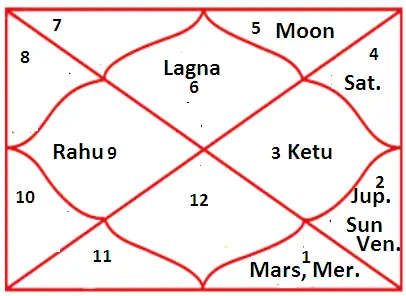
Here the Lagna is Kanya, whose lord is Mercury. Moon is in Simha.
1. Mercury is placed in the eighth house. Count thus-
The first lord (the lagna is Mercury) the lord of lagna. Counted from Kanya, (1st house). Tula (2nd house). Vrishchika (3rd house). Dhanu (4th house). Makar (5th house). Kumbha (6th house). Meena (7th house) and Mesha (8th house).
2. The second lord (lord of Tula) is Venus and is placed in the ninth house.
3. The third lord (lord of Vrishchika) is Mars and is placed in the eighth house.
4. The fourth lord (lord of Dhanu) is Jupiter placed in the ninth house.
5. The fifth lord (lord of Makar) is Saturn placed in the eleventh house.
6. The sixth lord (lord of Kumbha) is Saturn placed in the eleventh house.
7. The seventh lord (lord of Meena) is Jupiter placed in the ninth house.
8. The eighth lord (lord of Mesha) is placed in his own house in the eighth house.
9. The ninth lord (Venus) is in Vrisha in the ninth house and also his own house.
10. The tenth lord (lord of Mithuna) Mercury is placed in the eighth house.
11. The eleventh lord (lord of Karka) is in the twelfth house.
12. The twelfth lord (lord of Simha) Sun is placed in the ninth house.
Memory Tablet
The Memory tablet you must apply is P.A.C. In this description we have only shown how “p” is to be used.
A-(Aspect or Aspects)
Now remember that A is the middle part of the Memory Tablet PAC. Here, remember always, A means aspect or aspects. Remember then to analyse full normal aspects (7th) and the three special aspects of Mars, Jupiter and Saturn.
Through these aspects, (very special to Hindu astrology and very extraordinary) many hidden stories of a horoscope get revealed.
Now continue with the horoscope of John F Kennedy by applying
The second part of the Memory Tablet P.A.C. is aspect. Now analyse these aspects house and planet.
1. The first house (Kanya) or the Lagna receives the third aspect of Saturn and the fifth aspect of Jupiter. But there is no planet in the Lagna.
2. The second house (Tula) has no planet but receives the seventh aspects of both Mars and Mercury.
3. The third house (Vrishchika) has no planet but receives the seventh aspects of Sun, Jupiter and Venus and also the eighth aspect of Mars.
4. The fourth house (Dhanu) has Rahu in it but receives no aspects. (Ketu’s aspect is not considered. At any rate, I do not.)
5. The fifth house (Makar) has no planet but receives the seventh aspect of Saturn and Jupiter.
6. The sixth house has no planet but receives the aspect of Moon.
7. The seventh house has no planet and no aspect.
8. The eight house has Mars and Mercury and receives the aspect of Saturn.
9. The ninth house (Vrisha) has Sun, Jupiter and Venus but no aspect of any planet is there.
10. The tenth house has Ketu but does not receive any aspect of any planet. (Rahu’s aspect is not counted generally)
11. The eleventh house has Saturn and receives the fourth aspect of Mars from Mesha.
12. The twelfth house has the Moon but receives no aspect of any planet.
C-(Conjunction)
The third limb of the Memory Tablet is “C” or conjunction, which means when a planet joins another planet in a house it is said to be conjunct with the planet.
1. Lagna there is no planet and hence no conjunction.
2. The second house has no planet and no conjunction.
3. The third house has no planet and no conjunction.
4. The fourth house has Rahu but has no conjunction.
5. The fifth house house has no planet and has no conjunction.
6. The sixth house has no planet and has no conjunction.
7. The seventh house has no planet and has no conjunction.
8. The eight house has Mercury conjunct with Mars.
9. The ninth house has three planets conjunct with each other Jupiter, Venus and the Sun.
10. The tenth house has Ketu and there is no conjunction.
11. The eleventh house has Saturn and there is no conjunction.
12. The twelfth house has Moon and there is no conjunction.
Now take up your own horoscope or of anyone known to you and do a similar exercise. Apply PAC without fail.
Those who jump into yogas without understanding the psychological depth of a horoscope do harm to astrology and lovers of astrology. How the classical yogas are to be understood has not been understood by the writers who are mere compilers and not researchers.
Follow the steps given below
1. Never be in a hurry to jump to conclusions when you judge a horoscope.
2. You have to make a total analysis which starts with the PAC analysis.
3. The PAC approach gives you a total picture.
4. What about the yogas given in books on astrology is the question that must spring in the minds of those readers who have read such books. Let me tell you, for certain, that those books will give you a totally incohate picture of a horoscope. The reasons are
(a) Few writers have even understood that the classical yogas can function within the overall planetary promises, as a whole, of a horoscope, never outside.
There is for instance the well-known Gajakesari Yoga. In a bad horoscope what is the role of this famous yoga. This can be understood after lot of experience.
(b) All the yogas given in those books can become totally ineffective in many ways, because good ones get nullified by bad ones and the reverse also happens.
(c) Therefore ignore those yogas first and look at the series of examples given here to appreciate that judgment in Hindu astrology can mature only when a total picture of a horoscope emerges out.
(d) After doing some exercises about P.A.C, go next to the other memory Tablet which is D.A.R.E.S.
You will see in the examples given later how life takes a queer twists. With the intention to help people avoid memorizing. The traditional Indian method since ancient times has been to make a boy memories shlokas (Sanskrit stanzas) which gave in capsules all these principles. It is not possible to take up such boys these days and follow similar methods.
As it is many people who get interested in astrology, begin to learn the subject, late in their lives, and have no capacity to memorise. When learning through rote memory is not possible, what is surely possible is to learn through associative memory.
Take up some horoscopes and describe them systematically. Keep doing this exercise always.
You will hear and read about some professionals like MBA, engineers or doctors giving up their main line and taking up to astrology. Do not be impressed by all that. A professional who has not done well in his own profession over a period is not competent, generally, to be a good astrologer because astrology needs higher analytical gifts and ability to synthesise faster.
A Chartered Accountant found more money in astrology than in his own profession. Do not mistake him for a missionary astrologer.
Still, without becoming a professional astrologer (as a predictor or as a mill producing cook books on astrology), keep alive your interest in astrology as a lover of divine knowledge. It will help you spiritually and keep you away from the world of frauds which is what astrologers seem to be becoming all over the world.
Learn Astrology Easily
- Basics of Vedic Astrology
- Predictive Principles of Vedic Astrology
- D – Dhan Yoga in Horoscope
- A – Arishta or Malefic Influences in Horoscope
- R – Rajayogas in Horoscope
- E – Exchange of Lords of Houses
- Effect of Moon on Your Psychology
- Significations of Planets & Houses
- Timing Marriage by Vedic Astrology
- Astrology and Karma
- Astrology and Psychology
- Principles to Predict Political Carrier

0 Comments