Predictive Principles of Vedic Astrology
The Memory Table P.A.C. given before in previous post will be expanded now to make it a complete scheme. But before learning them, it is necessary to understand some technical terms of astrology which are used more commonly.
1. Kendras (Quadrants) The Lagna, the fourth, seventh and the tenth houses of the lagna are called kendras and the lords of those houses are called lords of kendras, wherever they may be placed in a horoscope.
2. Trikonas (Trines) – The lagna and the fifth and the ninth houses from the lagna are trines. The lords of the fifth and ninth houses have been described as trikonas which is a fallacy. The word ‘tri’ in Sanskrit means ‘three’. In what is known as the ashtakvarga, in trikona shodhana, the lagna, the fifth and the ninth houses are taken. Thus lagna lord is both a kendra lord and also the trikona lord.
3. Panapharas (Cadent) The second, fifth, the eighth and the eleventh houses are known as panapharas. Then a special term used is Upachaya house which are the third, sixth, tenth and eleventh houses and their lords.
4. Apoklimas (Succudent) – The third, sixth, ninth and the twelfth houses are known as apolklima. But since the ninth house is trikona, it is generally omitted from this category.
Points to Remember – In understanding the meaning of P.A.C. the combinations of the lords of these houses, or the aspect of one of them on a house or a planet or the mutual aspects of the lords of these houses reveal the secrets of horoscope. It is an area of ever-expanding research, very simple apparently, but very complex.
It will be good if a reader gets used to these terms after understanding how these terms come into a writer’s articles in so natural a way that the writer does not know that they may appear foreign to many.
The permutations and combinations of these, lords of kendras, trikonas, panapahars, apoklimas and upachayas are used for predictions.
Spiritual Qualities of Planets
India which is the land of the origin of four of the seven world religions, Hinduism, Buddhism, Jainism and Sikhism and has the most efficacious and numerous sadhanas (spiritual practices), has also given to the world the yoga system which is popular all over the world.
Very few astrologers know that Hindu astrology is the most developed spiritual astrology which is somehow, till now, kept as a great secret with the saints of India. Yet in some books of astrology, which is a different branch of astrology than the one being discussed here, there are many more hints about the spiritual side of human personality.
Yet rarely people in India go to astrologer to ask questions about their spiritual life for a very excellent reason. The people of India have the supreme advantage of learning their spiritual lessons, first at home from the elders in childhood, later they seek the guidance of some spiritual person, saints, yogis, gurus and other holy persons.
Then they have the supreme advantage of reading such rare spiritual literatures, in the Ramayan, the Mahabharata and the Puranas that they get most of the answers to their spiritual questions from these books.
My experience in U.S.A. and with people from the west coming to consult me in India has been that they seek answers which are sometimes quite ticklish because they have got interested in spiritual practices and, have rarely been in so advantageous position as Indians have of getting spiritual guidance form so many sources and so many persons.
To fulfill that need in discussing the nature of planets it becomes necessary to start with the spiritual qualities of planets. What is being listed below is not exhaustive but is sound enough for practical use by astrologer and lovers of astrology.
What spiritual qualities each planet (the nine we are using) represents is being given briefly.
1. Sun – The Sun, lord of our solar system, has been identified in some Sanskrit stotras as Lord Vishnu but generally, it is with Lord Shiva that he is identified. It does not matter which of the Trinity he represents.
The important point to remember is that he awakens the thirst for spiritual life, blesses one with divine knowledge, described as Gyana, which is why he has been described as Atmakaraka also (in Jaimini astrology where a planet with the highest degree becomes the Atmakaraka). Therefore, Sun is associated with philanthropic tendencies and has a Sattwick nature.
2. Moon – If the Sun is the atma (soul), the Moon is the Manas or mind. Mental qualities are represented by the Moon. It is the mind that creates the feeling of happiness or unhappiness. A mind that is under control is a mind that develops powers of concentration and meditation.
A Moon afflicted by Saturn and Mars creates strong feelings of detachment or vairagya. In the horoscopes of great yogis and saints this combination is generally seen.
Pure spiritual tendencies, love to go to sacred places, worshipping Goddess, kindness, soft and tender feelings born of Sattwick nature are associated with the Moon. It is for this reason that a strong, exalted or vargottama Moon has always been praised.
3. Mars – “Bhoomi-suto”, is a well-known synomym for Mars meaning the child of the earth. Also known as the commander in chief, Mars represents the determination to do sadhana, if such promises exist in any horoscope. He represents Lord Vishnu and his various forms. Among the Vedas he has been identified with the Sama Veda.
It is my experience that in the case of any guru, where he influences the 4th or the 10th houses, he builds ashrams. In the 5th house, Mars gives the drive to become the builder of religious institution.
Builders estate agents have to have a prominent Mars influencing their 4th or 10th houses or their lords. Extend it to men in religious and spiritual line and you will see builders of ashrams, temples, mosques, churches, synagogues and religious institutions, with a strong desire to acquire land and building.
4. Mercury – Maharshi Parashara prescribes recitation of the Vishnu Sahastranaama in the periods of Mercury. The identification of Mercury with Lord Vishnu being so clear, a strong and well-placed Mercury, (in the spiritual houses, like 4, 8,12 or the Dharma houses like 1, 5, 9 gives a deep yearning for the study of scriptures and also astrology which is a divine science, being the most prominent Vedanga.
Mercury generally causes the undertaking of pilgrimages but not for a long stay. To build temples of Lord Vishnu is a well-known quality of Mercury. The manifestations of Lord Vishnu in all forms being the identity of Mercury, he is a Vaishnava par excellence. Mercury promotes a strong tendency to acquire self-control.
Mercury being a ritualist, attraction for mantras and Yantras is a well known tendency released by Mercury. He represents Atharva Veda
5. Jupiter – An astrologer will be a poor predictor if Jupiter and Mercury are not good in his horoscope. The house of speech, the second house, getting associated with Jupiter through position or aspect shows gifts of prophecy, unless the second house or the second lord are bad otherwise.
It also makes one a good preacher. A preacher has to have knowledge of scriptures supported by personal spiritual experience. Jupiter represents the quintessence of dharma. The finer aspects of divine knowledge and spiritual practices like penances, worship of god, doing of charity are commonly associated with Jupiter. Varahamihira has praised the position of Jupiter in the 10th house.
Being a strict moralist, Jupiter motivates one to be ethical in conduct. Since Jupiter represents Lord Shiva, a Jupiter-dominated person does not mind making sacrifices for true religious and spiritual causes.
6. Venus – Traditionally, the Guru of Asuras, Venus is a learned religious person. Venusian traits can be showy. One may develop the tendency to turn his religious zeal into piety.
I have seen hundreds of horoscopes of men and women with Venus in the 10th house becoming more showy than sincere in spiritual pursuits. Perhaps, distractions in their lives, caused by Venus are many.
Among Vedas Venus represent Yajur Veda. The likeable and admirable side of Venus is love for religious songs, love to decorate religious places and compose music for, particularly female goddesses.
7. Saturn – Saturn described as the planet of misery is a totally fallacious statement. Without a favourable Saturn in the birth horoscope and in transit one can never develop deep detachment.
Saturn represents self-abnegation, tyaga. It is tyaga and Gyana that become real strong foundation for spiritual life. A weak Saturn has been seen to attract a sadhak, if there is also afflicted Moon, attraction towards inferior deities.
8. Rahu – Rahu has been praised by Ramanujacharya for dips in the Ganga and going to pilgrimages because he is an extrovert, unlike Ketu, who makes one an introvert. Rahu impels one to take to religious and spiritual practices many times in a rather unconventional way and, can cause attraction for non-conventional religious approach.
9. Ketu – It is difficult to decide who between Jupiter and Ketu is a better salvation-giver. Yet, Ketu has been called the salvation-giver because he is the embodiment of subtlest divine secrets. Ketu in the twelfth has been praised. Ketu always attracts one towards seclusion, observance of mouna the vow of silence.
Persons whom these Planets Represent in Daily Life
Now, if we take the normal day to day, mundane affairs, these very planets represent the following worldly persons.
The Sun
The king of the solar system, is the king always and everywhere. The level of regal splendour he shows will depend on his condition in a horoscope.
Family – The father in a family and paternal relations, the Sun is also a dignified administrative authority.
Society – The King in a monarchy, the Sun is the dignitary in modern democracies and represents highly placed persons whether in government service or private firms.
The Moon
Like the Sun, the other planet representing royalty is the Moon.
Family – Represents the mother and everything connected with mother.
Society – The wise men (Dwija) of the society, popular person and in democracies, the Moon aspected by Saturn represents the charisma some personalities develop.
Mars
Mars is the natural commander-in-chief in astrology.
Family – Brothers, sisters.
Notable – Some astrologers following the Bhrigu system of Hindu astrology give to Mars the role of a woman in a man’s life. While many astrologers do not accept this, there is strong enough reason to go deeper into this aspect as some of my researches prove this to be very valid.
Society – Mars gives an important marital point which pertains to marriage which is why in Hindu astrology so much stress is laid on Mangalya (happiness of a marriage) and also Kujadosha (Kuja is a synonym for Mars). In social life, Mars represents the army, the police and men in uniform, administrators, men in high position, rulership, estate agents etc.
Mercury
In astrology Mercury is the prince.
Family – Cousins, maternal uncles.
Notable – In Uttar-Kalamrita, Kalidas attributes to Mercury some other special significations: maternal grand-father, and younger coborns and or brothers and sisters.
Notable – In a woman’s life Mercury represents, if afflicted by Saturn a husband with less or no sexual virility.
Society – Mercury represents knowledge and in modern life, business. So this planet has many great significations of very wide variety. Mathematicians, sculptors, astrologers, astronomers, scholars, speakers, writers, men who know the secrets of mantras and yantras.
In modern age. Mercury is the financial expert, accountant, auditor, journalist, newspaper man, paper merchant etc.
Notable – The association of Mercury with certain planets in some rashis from the lagna is the clue to finding it out. Lot of new researches will have to be done in this area.
Jupiter
Jupiter who is given the honored place of being the guru of gods, represents, the divine, the sacred.
Family – Children, elder brother, respected elders in the family (whose intervention and advice helps solve family problems)
Notable – In Uttar Kalamrita, the other significations given to Jupiter are grandsons and also grand-father.
Notable – In Bhrigu astrology, Jupiter is said to represent the husband of a woman just as Mars is said to represent the wife of a man.
Society – Traditionally, the priest, the scholar, the adviser to the king (in ancient times), Jupiter represents many new modern professionals.
Notable – The judge, the teacher, the lawyer, the adviser in new modern forms become legal experts, the management experts, the psychologists, the bankers etc.
Venus
Venus, traditionally the guru of asuras (monsters), is described as the lord of sixty-four arts, meaning that Venus represents, culture and sophistication.
Family – Represents the sex-life of married partners in a tradition bound society otherwise, the sex-life of an individual. Generally Venus has been treated as wife. For those born after sun-rise Venus is said to take the place of Moon and becomes the mother.
Notable – Generally Venus represents family prosperity, conveyances, jewellery, and precious possessions.
Society – Venus being representative of arts, all form of arts, fine or commercial, dance, song, drama, literature, poetry being its sole domain, dramatists, poets, dancers etc. are Venus-dominant personalities.
Notable – In modern context, the perfumers, hoteliers, owners of restaurant, computer-software men and even those who deal with flesh- trade fall under the vast Venusian umbrella.
Saturn
Hindu astrologers are mostly superstitious in their understanding and treatment of the significations of Saturn. True, Saturn represents, trouble, sorrow, old age, sickness. Yet in all the great classics of Hindu astrology Saturn has been given some other beneficent roles which are overlooked.
Family – Old men and servants in the family. Old, dilapidated houses specially made of bricks. For those born at night Saturn represents father, taking the place of the Sun, the natural significator of father.
Society – If the Sun is the aristocrat, Saturn is the democrat while Mars is the dictator. These hints help us in making predictions about the type of government a nation will have at a given point of time. Lower classes, democrats, crippled persons, old men, are represented by Saturn in traditional astrology.
In the changed socio-economic times of ours, Saturn is the seeker of powers through elections to democratic bodies, iron-smiths and also industrialists (in cooperation with Mars), a psychologist in cooperation with Jupiter, an artist in cooperation with Venus, a sculptor in cooperation with Mercury etc.
Notable – Astrologers who fail to seek the very wide and sweeping range of all new professions created by Saturn will fall into thousands of errors of judgments.
Rahu
Next to Saturn the most condemned planet is Rahu. Unless astrologers do new researches and see the positive side of these planets, more damage will be done to astrology than has already been done so far.
Family – Paternal grand-parents (though Uttar Kalamrita also uses Rahu for maternal grand-parents), old, sick person in the family and those that become non-comformists.
Society – The foreigner, the engineer, the architect, the space engineer, the politician, air hostesses, aeroplane pilots and manifold new technical and semi-technical professions fall in the domain of Rahu.
Ketu
Ketu is the most baffling planet in astrology, spiritual, divine on the one hand and baffling in a medical sense.
Family – Represents maternal grand-parents (though Uttara Kalamrita takes paternal grand-parents), the slightly unorthodox members of the family.
Society – Ketu is the planet which plays key role in shaping a doctor or other men in semi-medical or alternative systems of medicine. Ketu, combined with other planets, produces inventors, men dealing with subtle secrets of nature around our world.
Notable – Some hints have been given here about the persons represented by different planets some of them are traditional and some of them are additional.
For instance Ketu represents languages and linguists. These days when people learn computer it naturally falls under Ketu because there is computer language to be learnt.
If planets combine, aspect each other in certain houses from the lagna, the meaning of this should be interpreted with an open mind. The classical principle should never be overlooked and the new meaning must be discovered otherwise astrological research will remain stagnant.
The Spirituality Associated with Houses
नमस्कार । मेरा नाम अजय शर्मा है। मैं इस ब्लाग का लेखक और ज्योतिष विशेषज्ञ हूँ । अगर आप अपनी जन्मपत्री मुझे दिखाना चाहते हैं या कोई परामर्श चाहते है तो मुझे मेरे मोबाईल नम्बर (+91) 7234 92 3855 पर सम्पर्क कर सकते हैं । परामर्श शुल्क 251 रु है। पेमेंट आप नीचे दिये QR CODE को स्कैन कर के कर सकते हैं। कुंडली दिखाने के लिये पेमेंट के स्क्रीन शॉट के साथ जन्म समय और स्थान का विवरण 7234 92 3855 पर वाट्सप करें । धन्यवाद ।

In delineating the effects of each house, the start should again be made with the spiritual promise of each house. By each house from the Lagna which is always the first house. Thus, for a person born with Meena lagna the first house is Meena, the second house Mesha and the twelfth house Kumbha etc.
Since spiritual astrology is generally kept a secret and astrologers do not pay attention to it, emphasis should be laid on this aspect both for the spiritual guidance of the person concerned and for preparation for a fine spiritual era into which mankind will enter after 2002 A.D.
The First House
The first house representing oneself, shows the beginning of awareness of spiritual side of human life. If three or more planets are in the first house, such persons, inspite of all distractions, can practice self-control with determination, and successfully.
From the first house springs the desire to enjoy peace generally and the tendency to renounce because the first stage of renunciation is physical.
To understand it, the Four Purusharthas of classical Indian tradition should be understood. The first one is Dharma (religious conduct), the second is Artha (the desire to earn money), the third is the kaama to enjoy life physically and the last is Moksha to make efforts to get salvation.
In Hindu astrology therefore starting from the lagna there are four trines for each the purusharthas which are:
Dharma – Lagna, Fifth house, Ninth house
Artha – Second house, Sixth house, Tenth house
Kaama – Third house, Seventh house, Eleventh house
Moksha – Fourth house, Eighth house, Twelfth house
There is another set of four trines which depends on the division of human life into four parts, Brahmacharya (life of celibacy) Grihastha (the life of a householder) Vanaprastha (detaching oneself) from house-holder’s duties) and Sanyas (life of renunciation). The scheme of division is the same as in the earlier trines.
Brahmacharya – Lagna, Fifth house, Ninth house
Grihastha – Second house, Sixth house, Tenth house
Vanaprastha – Third house, Seventh house, Eleventh house
Sanyas – Fourth house, Eighth house, Twelfth house
In judging the spiritual importance of each of these houses, these trines should be kept in the mind.
It is always important to remember that the lagna and lord must not be ill-placed (in the eighth house, the sixth house or the twelfth house) and must not be afflicted by Saturn, Mars, Rahu, Ketu particularly through conjunction or aspect. In such a case the health may be bad.
It is sound health that alone ensures any type of achievement in anyone’s life, including spiritual achievements. It is in rare cases that a person with ill health but strong sense of renunciation can be spiritually exalted. But we must proceed on the premise that it is sound health that is the foundation of even good spiritual life.
The Second House
The family environment gives to one some spiritual tendencies, which is what the second house represents, being the house of Kutumba (or the family one is brought up in). Faith in religious and spiritual traditions are inherited and also acquired generally from parents.
The second house represents it, besides, also being the house of speech. See the planets (particularly Jupiter, Venus, Mercury) without affliction to examine whether one has the tendency to speak truth or falsehood.
The second also being the house of earnings, monetary gains etc., the charity one does with money and gifts are also to be seen from the second house.
Note – In this respect the role of the twelfth house is more important.
The Third House
The third house known as the house of valour and courage becomes favorable if there is a malefic like Rahu, Saturn, Mars, Ketu in it. It shows a determination to apply oneself to spiritual practices with strong will. The third house also is to be seen for short and quick pilgrimages.
Note – The third house, according to Maharshi Parashara, is the house of upadesha or religious preaching.
The Fourth House
The fourth house representing buildings, represents the religious-philanthropic institutions one builds and also the trusts one creates or religious, philanthropic and other good trusts with the money one has.
In the life of an individual the fourth house represents his desire to pursue his spiritual life in the quiet surroundings of a place, house or ashram with rhythmic regularity. In the case of a yogi it can represent pranayama or breath-control. But if such a house is disturbed, such persons find that by moving from one place to another only they can follow their spiritual pursuits.
The Fifth House
An important principle of Hindu astrology is that if a planet aspects its own house, that house gets strengthened.
This should be seen very closely in the case of the fifth house around which revolves the realization of the potency of mantra, yantra, because this house is important in two ways: in the case of the individual whose horoscope is being examined, it represents the spiritual merit of his past life and in the case of his father, it is the house of his spiritual merit of his present life.
It is a good fifth house that bestows viveka or a sense of discrimination and deep spiritual wisdom born both of the reading of scriptures and spirituals practices.
The Sixth House
In the life of a spiritual practitioner fifteen types of distractions are normal. More often than not these take a person away from the desired spiritual path. To overcome such distractions, a malefic in the sixth house is always good. As it is, a malefic in the sixth house is good for ensuring sound health and the tenacity to overcome obstacles.
In spiritual life this house helps in developing one pointed concentration.
The Seventh House
This house of sex is also the house of sex-sublimination. It is when the kundalini power rises high that sexual lust gets transformed into love and a sadhak feel the spiritual vibrations of the rising kundalini.
The Eighth House
It should be noticed that the fourth house is the house of spirituality and salvation in the trines given before. The eighth house is the second of such house, but being a secret house (eighth house is a hidden house) one practices one’s sadhana in secluded and cloistered places.
It is true that this house also represents agonies which must include spiritual disappointments in the act attaining a blissful state of samadhi.
The Ninth House
Next to the fifth house, the house on which all astrologers lay greatest stress for spiritual development is the ninth house. Yet, there is a controversy among astrologers whether it is the ninth house or the fifth house that is to be seen for the spiritual merit of the past life.
While majority of astrologers see the fifth house for the merit of the past life, it is also logical to see that after the eighth house of samadhi that the spiritual merit of this life blossoms out.
The ninth house therefore is to be examined for all acts of penance, pilgrimage, worship of gods.
It is the house which represented the last stage of full spiritual development, after which one can become a guru or a spiritual guide. This house also is for father, who is one of the early gurus of a child.
Note – The fourth house which is the first house of the moksha triangle represents mother which is why serving one’s mother is the service to adi-guru (the first guru).
The ninth house, the last of the dharma triangle, shows the importance of service to one’s father, as the key-note of religious progress.
It is for this reason that the Sanskrit saying. “Matri devo bhava” (let mother be the goddess) and “Pitro devo bhava” (let father be the god) is the eternal lesson children are taught to lay proper foundation of their spiritual life.
Inferentially, those who are cruel to their parents cannot hope to be spiritually successful in their practices. This is a harsh spiritual reality which will not be palatable to many modern young people. Yet an astrologer cannot afford to overlook this.
The Tenth House
The tenth house is the house of those deeds which are noticed. A person who has potentised a mantra and has become a guru, wins social recognition through his deeds (even misdeeds).
It is for this reason that Jupiter, the greatest benefic is preferred most in this house for holy deeds because the tenth house is the house of religious, spiritual and ritualistic deeds.
Note – In the case of a guru the tenth house shows the quality of his deeds, along with the lord of the tenth house.
The Eleventh House
In a spiritual sense, the eleventh house is a very enigmatic house. Benefics in it will attract one to worship of many gods and great scriptural scholarship and authorship. Many planets in it will bring, as donations to a guru, lot of money as the eleventh house is the last of the kama triangle or desires.
Such desires can be good and evil. The eleventh house is thus the house of the last of the temptations a religious person has to face which must be overcome to reach the final destination, salvation.
The Twelfth House
The twelfth house, the condition of the twelfth lord and Ketu are the salvation giving factors. A bad twelfth house can ruin all the spiritual promises of an otherwise good horoscope.
Note – What has been given so far here is only a bare outline of the spiritual promise inherent in a horoscope. These very promises are to be examined in greater details through many other finer analysis. The use of Vimshamsha (one-twentieth division horoscope) will have to be brought into use.
Jaimini astrology should be used before any predictions about anyone’s spiritual life is given otherwise, spiritual
What is to be Seen from which House?
So far what has been given is the spiritual aspects associated with each house from the lagna. These days more and more people have generally two additional questions to ask, the first about their spiritual life and the other about their ailments.
The other traditionally associated significations with the houses have been given in detail in many books, fortunately now available in translation in English. But it is necessary to sound a warning here, do not take any of the interpretations given in them as being dogmatic and unalterable.
This mistake is committed by some Indians who do not make an in-depth study of astrology and study other techniques. What are given in these classics are aids to predictions, not predictions themselves.
Keeping this forewarning in the mind it will be useful to know what each house represents.
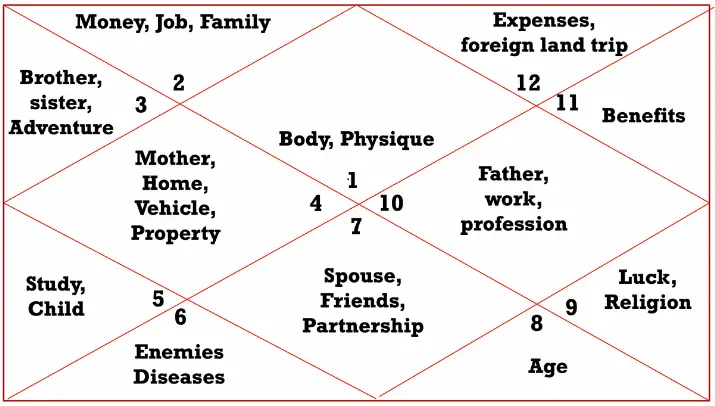
The Lagna – One is born in a particular sign, which is his lagna and therefore the first house. His personality will partake of the characteristics of those signs, which will be discussed later.
The First House – The first house represents the physical body, good or ill-health, the early part of life, the personal development of the child and the character as a whole.
The Second House – It is known as kutumba or the family of one’s parents and is to be seen for speech, the food one eats, the money one gets and also death.
The Third House – Traditionally, this house is to be seen for brothers and sisters, short journeys, letters and quick writing. But these days it is necessary to examine it for sports, artistic talents, and business agencies also.
The Fourth House – Mother, land, conveyances, happiness are the traditional subject to be seen from the fourth house. Extending it, a doctor’s clinic, an artist’s studio, a philanthropist’s trust and an industrialist’s factories are the modern additions.
The Fifth House – It is the house of education (though some take the fourth house as education) intelligence, children and the power of discrimination.
The Sixth House – Diseases, opposition, debts, injuries are the negative factors associated with this house. On the positive side, accumulation of wealth (it being the second of the artha trine), sports, adventures and father’s profession are seen from this house.
The Seventh House – Traditionally, marriage but these days living together, therefore wife, lover, sex life are associated with this house. These days, it should be seen for business and business partnership, foreign countries, and even settlement abroad and death.
The Eighth House – Legacies, inheritance, sudden financial gains, wills are the positive side of this house while the negative side is long illnesses, cause of death, sexual and conjugal life.
The Ninth House – The father (though the tenth house should also be seen) spiritual tendencies, devotion, learning, pilgrimages, association with legal and religious personalities are the commonest factors seen from this house. It being the house of luck, a good ninth house improves a horoscope.
The Tenth House – One’s profession (the sixth house is also employment) fame, honors, respect, dignity and one’s achievements are seen from this house.
The Eleventh House – All types of gains, titles, honors, elder brothers and sisters, business profits are to be seen.
The Twelfth House – Loss, expenditure, waste etc. are the traditional factors associated with this house. These days, foreign journeys, getting settled in a foreign country, trade with a foreign country, jail, imprisonment are necessary and inevitable events to be gleaned from this house. For spiritual practitioners this is the most important house for the promise of spiritual life and salvation.
As has been stated, a long list of events and things to be seen from each of the house can be compiled in hundreds of pages. What has been given here is for day to day use only.
Useful Information About Rashis
In making predictions a bout various events the most essential information that must be made use of is being given in descriptive form partly and in chart-form, partly.
In making subtle predictions, the information is made use of but at an advanced stage of an astrological career. The rashis are given directions, colour, caste and it is also explained how they rise. The last bit of information about the nature of their rise is made use of for predicting how quickly any work is done when a question is put in prashna astrology (horary) how soon a work will be done or not and whether there is any promise of auspicious results.
Similarly the quality of a rashi, Sattwic (Spirituality) Rajasic (activity) and Tamasic (inertia) is also useful in psychological-spiritual, mental and other characteristics that manifest in the mahadasha and the antardasha running at a given time.
Expanded Memory Tablet
Earlier, part of Memory Tablet was given, P.A.C. Now the full Memory Table is being given which I have taught successfully to thousands of students who have found it working as a sound methodological analysis. The second half of the memory tablet is D.A.R.E.S.
D – for Dhana or wealth, monetary gains, the lords that should be seen for this are of the first, second, fifth, ninth and eleventh and of course cords of those houses.
A – for Arista or misfortunes of ill health and tragic events. The lords and houses to be seen are the third, sixth, eight and twelfth including the lagna invariably and its lord.
R – for Rajayoga or combination for rise professionally and otherwise promise of distinctions in various fields. The houses and the lords to be seen are the first, fourth, seventh and tenth and their combinations (PAC) with the lords of the fifth and the ninth houses.
E – for Exchange Some horoscopes have some very special features by overlooking which we astrologers commit serious mistakes.
S – for special aspects, if any.
So the full Memory Tablet is P.A.C.D.A.R.E.S. This is to be applied with the mahadasha and its sub-periods and then transit of planets of predictions. Each of the D.A.R.E.S. is being explained now, one by one in next blog posts.
The method evolved here helps one grasp the essentials of horoscope well. It is after this preliminary exercise has been done, that one should go into details.
Learn Astrology Easily
- Basics of Vedic Astrology
- Predictive Principles of Vedic Astrology
- D – Dhan Yoga in Horoscope
- A – Arishta or Malefic Influences in Horoscope
- R – Rajayogas in Horoscope
- E – Exchange of Lords of Houses
- Effect of Moon on Your Psychology
- Significations of Planets & Houses
- Timing Marriage by Vedic Astrology
- Astrology and Karma
- Astrology and Psychology
- Principles to Predict Political Carrier


0 Comments