Astrology and Karma
In all the writings of writers on astrological subjects, the relation between astrology and karma has been discussed sometime or the other. In astrology we can easily trace karma-phala through the mahadasha system.
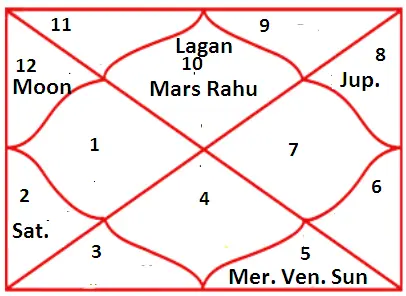
For instance see Chart 1. This lady was passing through the dasha of Moon-Venus. It can easily be seen:
- From the Lagna the 7th lord Jupiter in the 6th house aspected by Mars.
- The 7th house has Saturn, again aspected by Mars.
- From the Moon the 7th lord Venus has gone into the 6th house while the 6th lord Mars has gone into the 7th house.
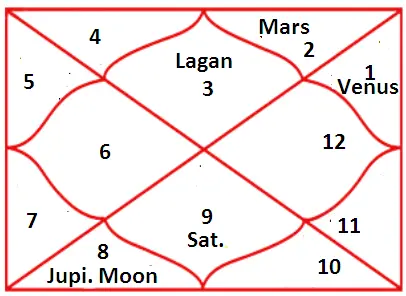
In the mahadasha of the Moon which is with the 7th lord in the 6th house from the Lagna and in the antardasha of Venus which is the 7th lord from Moon in the 6th house, there had to be strong difference of opinion with her husband. Finally she had to divorce her husband.
Astrologers can easily see that certain planetary pattern in every horoscope represents unavoidable proofs or pre-destination.
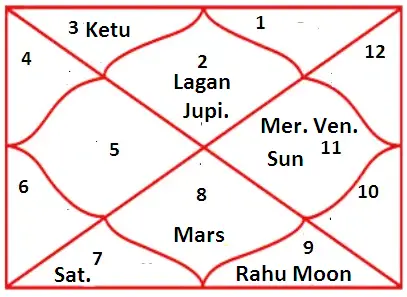
Similarly, a person born with a horoscope (Chart 2). In the mahadasha of Mercury, antardasha of Sun and pratyantar dasha of Mars, there was a big theft in his house, as a result of which jewellery nearly worth of Rs. 500000 of his wife was stolen.
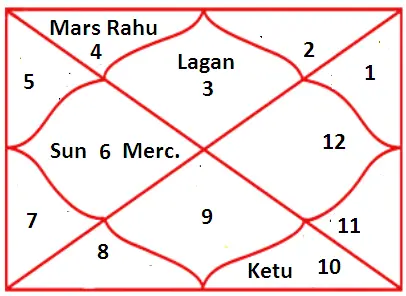
Such an incident is explainable only through the application of astrological principles. This person has been suffering from losses and thefts of property repeatedly.
It is necessary for us to stress here that the theory of astrology is based 100% on the theory of karma, reincarnation. More scientific clues are now coming from the West while for Indians it has only been a matter of traditional belief so far.
Astrology, Fate and Freewill
For non-astrologers the debate about fate and freewill is purely philosophical. Most of the writers produce confusing volumes of books on the subject and mesmerize their readers with their confusions.
For the astrologer, it is not a debate but only a question of developing more and more of his ability to see it, as he alone can, since astrology, better described as Jyotisha, is a Pratyaksha Shastra or a proofs-filled subject of classical learning. What the astrologer sees can be divided into three parts:
- That area where destiny must prevail and man has no choice.
- That part where man can exercise his freewill to improve the best of the pre-destined results or overcome the predestined misfortuens, partly may be even fully. It is, however, debatable whether man can ever overcome completely his pre-destined misfortunes.
- That mixed area where the astrologer cannot see himself where strokes of destiny become more mightily dominant over freewill or vice-versa.
A thumb rule which can be replicated with sixty percent success is that “If the third lord is in the eleventh house or the eleventh lord in the third, the person will either be the eldest or the youngest child of his parents; or will be the eldest or the youngest among sister or brothers”.
Since we are talking of destiny, ask one important question. Does a person have a choice to be born as the eldest or the youngest child of his parents or, is it decided by destiny.
What then is destiny? Whether one believes in destiny or not, the argument must start with the question whether one had any choice to be born at a particular time, in a particular family with particular parents in a particular surrounding.
At what stage could one have exercised any choice to select one’s parents, brothers, sisters, the family to be born in, be it a wealthy one or a poor one?
If a man sits down to list out what in his life has happened without his having any choice in them, there is no reason why he should not believe in destiny.
Area of Freewill
There are areas in which a person can exercise his freewill but within the orbit of the pre-destined, not outside it. This can be illustrated in many different ways on different horoscopes.
For our example let us take the role of astrological counseling for career counseling starting with pinpointing the educational choices before a student. To do it note down:
- The nakshatra in which the fifth lord from the Lagna is posited and the Influence of other planets and the lord of the house involved.
- Then see the influences on the fifth house and the fifth lord from Mercury.
- Combine both; the influences of planets to decide the various educational choices available.
- The strongest of those choices and the mahadasha running will ultimately decide the choice of higher education and the career pattern.
Thus within the pre-destined orbit, a person can exercise some choices. It is being illustrated here.
The First Example – The fifth lord is Saturn in his own nakshatra and in the house of the Moon; the fifth house from Mercury is Capricorn which receives the aspect of both Saturn and Mars and the house involved is Capricorn (owned by Saturn).
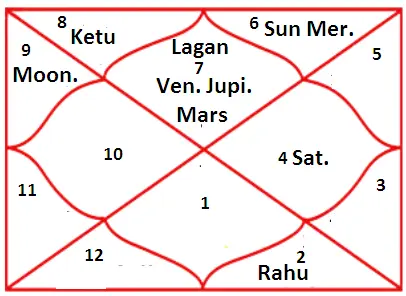
Totaling up, Saturn comes into play thrice, Mars once and the Moon once. The education has to be technical. The Moon which represents vehicles led this man into completing a diploma in automobile-engineering.
Here the choice could even have been irrigation, electrical engineering. But the Moon in the third house of communications decided it in favour of automobile-engineering.
The Second Example – Here the choice is not much as both from the Lagna and Mercury the fifth house has Saturn, Mars and the Moon all of which are in the nakshatra of Mercury.
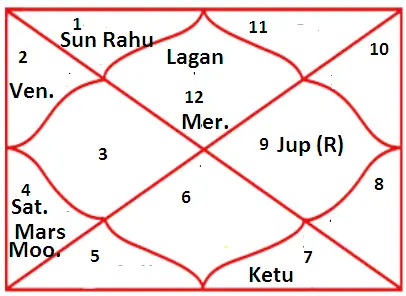
He learnt mechanical engineering, later learnt about petrol pump management and finally an independent business in construction work.
The Third Example – Here the fifth house has Saturn aspected by Jupiter and the fifth house is Taurus owned by Venus; the fifth lord Venus is in his own nakshatra but with the Sun and Mercury aspected by Mars.
Totalling up the influence of Saturn, Jupiter and Venus show Venusian influences predominating. The conjuction of Mercury with the Venus shows accountancy, commerce economics etc.
This girl was advised to do a course in fashion designing, after doing her B.Com. (a course in commerce). She has successfully completed her diploma in fashion designing and has started her business.
The Fourth Example – Here the fifth lord, Mercury is in the nakshatra of Rahu who in turn is in the sign of Jupiter and with Moon.
The fifth house from Mercury is Gemini with Ketu in it receiving the aspects of the Moon, Rahu and Mars. The fifth lord with the Sun and Venus showed all the other influences.
नमस्कार । मेरा नाम अजय शर्मा है। मैं इस ब्लाग का लेखक और ज्योतिष विशेषज्ञ हूँ । अगर आप अपनी जन्मपत्री मुझे दिखाना चाहते हैं या कोई परामर्श चाहते है तो मुझे मेरे मोबाईल नम्बर (+91) 7234 92 3855 पर सम्पर्क कर सकते हैं । परामर्श शुल्क 251 रु है। पेमेंट आप नीचे दिये QR CODE को स्कैन कर के कर सकते हैं। कुंडली दिखाने के लिये पेमेंट के स्क्रीन शॉट के साथ जन्म समय और स्थान का विवरण 7234 92 3855 पर वाट्सप करें । धन्यवाद ।

This woman studied economics, history, learnt music, dance and finally underwent training in tax-administration professionally after she became an income-tax officer.
These four instances, like hundreds will show that the deeper an astrologer works on similar lines, the finer and clearer become the choices available.
This lady could develop interest in her professional subjects and also artistic subjects, one taking precedence over the other as the dasha changes.
The versatile talents of a person can thus be pointed out and the person can be advised properly when to concentrate on what, not one at the cost of the other, but following a well-planned scheme of changing priorities.
In all these examples the choices are within the predestined limits only.
The Boy
Yashovardhan, one and a half years old boy, was admitted in the Paediatric Intensive Care Unit of AllMS, New Delhi. He was transferred from R.M.L. Hosipital, New Delhi on a portable ventilator. During his stay of about 36 hours at R.M.L. Hospital he was found to have severe combined respiratory-metabolic acidosis, hyponatremia and hypokalemia.
At one stage it seems, the doctors had declared the boy dead. When the horoscope of the boy was brought, the parents were asked to bring their horoscopes also. A combined reading of all the three horoscopes was done with no firm conviction and only non- committal prediction was given, stage by stage thus:
- No benefic is in quadrants and Mercury as the sixth lord of accidents with two malefics was no good.
- The lord of the lagna, Saturn is totally combust.
- Jupiter in the eighth could be a ray of hope.
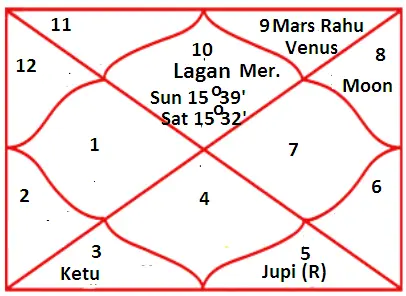
The child was passing through the period of Mercury-Rahu- Venus. Here Mercury as the sixth lord and Rahu and Venus in the twelfth house made the child’s hospitalisation inevitable.
In transit, Saturn in Aquarius and Mars in Leo occupying two-eighth axis was not helpful at all. Only the aspect of Jupiter from Leo on Rahu and Venus could again raise some hopes.
But from the Moon, Mercury became the eighth lord, while Rahu in the second house and Venus as the seventh lord in the second house destroyed any chances of optimistic view of this terrible situation.
- The first four years in a child’s horoscope, its span of life is dependent on the karmas of the mother in her past life;
- the next four years on father’s karma and
- from eighth year onward the child’s own karmas of past life, is a well known astrological Instruction.
It is for this reason that astrologer are asked not to make any prediction about a child it has crossed the age of twelve years.
According to the GITA, III-27, all the qualities, Satwic, Rajasic and Tamasic, inherent in nature are the motive forces for all the karmas.
If a man thinks that he is doing any karma he is mistaken because he should know that he does what his inherent satwick, rajasie or tamasic qualities impel him to do. Thus no man can really accept fate and remain idle.
But how are the two, fate and freewill to be reconciled. The best is to quote the Mahabharata in his context, wherein to the question of the eldest Pandava Yuddhishtra, the great Bhishma answered thus:
The seed: Karma which sprouts into a plant, tree, leaves, flowers and fruits and all that.
The Farm: Freewill is like farming without which no seed can sprout. Fate is the seed and efforts (freewill) is the farm, on which is grown the harvest of life. Both, fate and efforts have to co-exist. The word used for efforts is purushartha.
Results of Karmas: Every man has to enjoy or suffer the results of his good and bad karmas, himself. It is well-known and has been observed by all.
Good karmas give good results and bad karmas bad results. It is one’s own karmas that yield results always.
The Hard Trier: The person who works hard gets respect and dignity according to his own destiny, and luck. Through hard work, which includes spiritual practices as well, a person gets honour and dignity. The lazy one who puts in no efforts is like a fool who allows salt to be spilled on the wounds of his misfortunes.
Thus through hard work one gets enjoyments, heavenly bliss, intellectuality and steadfastness. The Idler, depending only on fate and chance, achieves nothing.
Money, circle of friends, glory and great achievements are reserved only for the hard trier.
If there were to be no such thing as the results of karmas the entire world would become idle and everyone would wait for his luck to give him whatever is due to him. It is the efforts put in that follow fate. Nothing can be given by Fate if no efforts are put in.
The sole witness of all karmas of a person is his own soul. Soul is his friend or his enemy.
Therefore very determined effort can render the results of many karmas of the past totally nugatory, as though no karma was done.
Conclusions
1. Divine persons do only good Karmas. Everything achievable is achieved through good karmas. Fate will be less inscrutable for the divine person. (What has been given here is a liberal translation from the Mahabharata)
2. In the greatest book of spiriual wisdom in the world, The Gita, the instructions are clear: yoga is efficient karma, a true devotee of his is efficient but non-attached. Therefore man’s duty is do his karmas and not expect the results to be according to his wishes. He should accept gracefully the result of his karmas, but should never stop doing his karma dispassionately and efficiently.
Astrology is the only super-science known to mankind which helps man know the trends of results and the role of destiny whose importance is stressed in The Gita.
Thus again: there is a project, there is a project manager, there is the act of implementation and there are implements of action but there is that fifth, unknown factor, Destiny. That role can be seen only by an astrologer, sometimes very successfully and sometimes very wrongly.
0 Comments